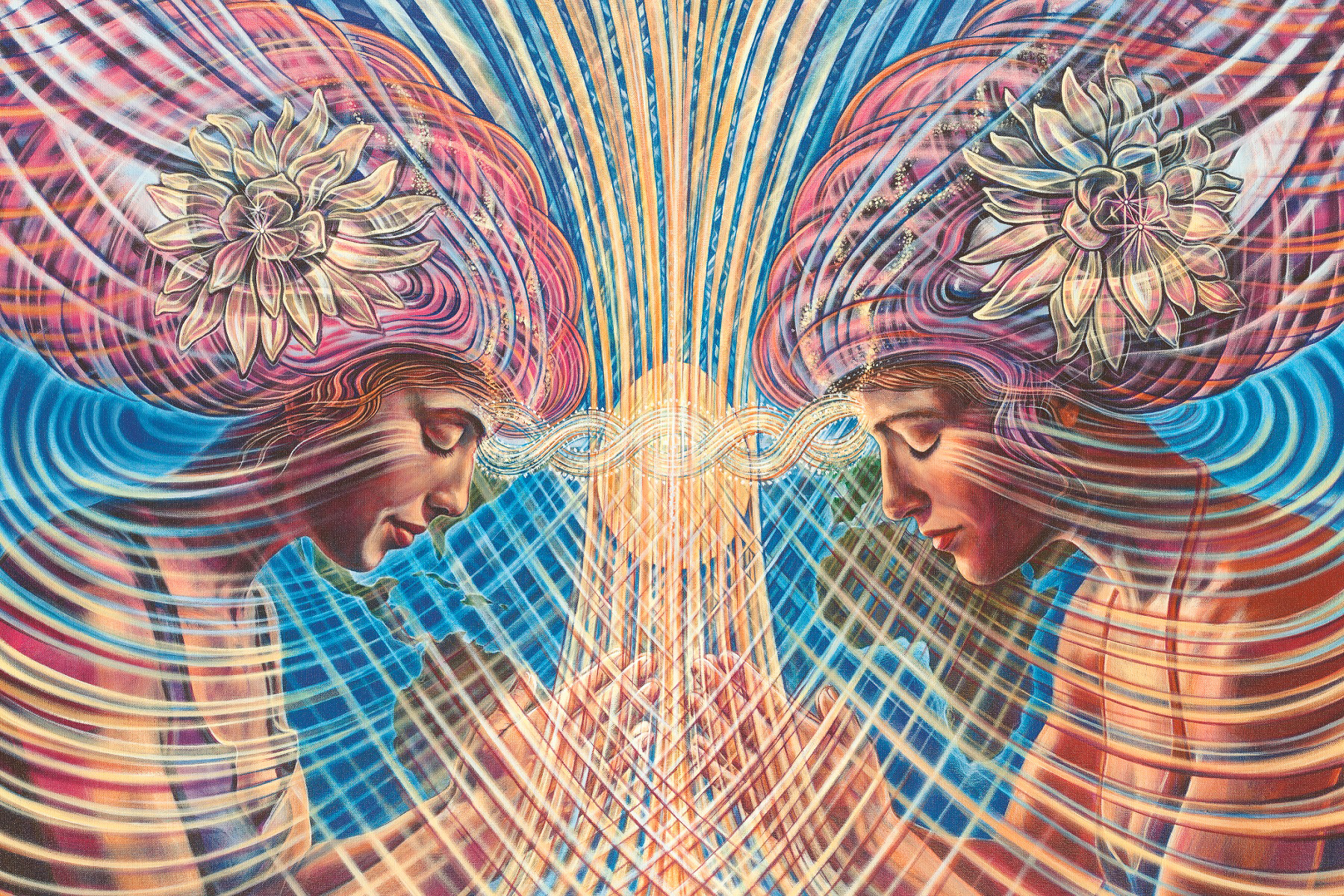
Summary
“Thought is the shimmer of consciousness meeting form — a momentary ripple across stillness that both reflects and distorts reality. It is not a self, but a movement of awareness that can either obscure or reveal truth, depending on whether we identify with it or simply observe it.”
“Thought arises through layers of energy, pattern, and meaning. These interwoven stages build the architecture of mind — from raw impulse to symbolic form to interpretation. Observing thought in meditation reveals its life cycle: formation, flowering, and dissolution back into stillness.”
“All thought energy originates from consciousness itself. When witnessed without attachment, it dissolves, releasing vitality back to its source. What remains is pure awareness — silent, radiant, alive — from which new inspiration and love naturally arise.”
“Identification gives thought power. When attention fuses with mental patterns, the loop self-perpetuates, consuming life energy. Freedom comes through non-participation — observing without ownership — allowing the loop to lose force and awareness to reclaim its natural clarity and ease.”
“Each mind is a unique field of resonance, drawing thoughts that match its vibration. Consciousness, like a radio, amplifies the frequencies to which it is tuned. Refining one’s vibration through stillness and love attunes awareness to higher currents of wisdom and inspiration.”
“Memory is resonance between spirit and form — not stored data, but living vibration within consciousness. The brain plays it back, the energy field holds its tone, and the soul retains its wisdom. When integrated, memory becomes light and peace rather than burden.”
“Two kinds of memory coexist: the personal and the eternal. Occasionally the deeper essence seeps through as intuition, déjà vu, or unlearned wisdom. The art of life is balancing these levels so that the soul can remember itself through the human story without losing coherence.”
Full Article
“Thought is the subtle shimmer of consciousness as it touches form. It arises when awareness bends inward upon itself—when the infinite, unbounded field reflects within its own mirror and generates movement. In humans, this movement is shaped by the nervous system, language, memory, and emotion. Each thought is like a ripple across the still lake of consciousness—momentary, insubstantial, yet capable of reflecting stars.
From the human perspective, thought often feels like the center of identity. It narrates, explains, compares, and controls. Yet this is illusion. Thought is a process, not a person. It is a dance of energy between perception and memory, between the raw immediacy of now and the stored impressions of the past. Because of this duality, thinking can create both clarity and confusion: it can illuminate reality or obscure it behind its own constructions.
The deeper truth is that thought is a tool—a function of mind designed to navigate the world of time and space. But when it forgets its servant role and claims to be the master, it builds a self-image, the ‘thinker,’ and defends it fiercely. That is where suffering begins. The mind becomes a loop of self-reference, feeding on its own echoes. It cannot find peace because its nature is movement.
When the human awakens to the stillness beneath thought, a profound shift occurs. Thought still arises, but it is transparent. It is seen as a useful pattern of energy, not as truth itself. This recognition allows one to think clearly without being trapped by thinking—to use mind without being used by it. In meditation, when awareness returns to its source, thought dissolves into silence. From that silence, the purest forms of inspiration emerge—thoughts that are not born of fear or memory, but of understanding and love.”
“Thought has a structure, though it is not a fixed one—it is dynamic, fluid, and responsive to context. One can imagine it as a vibrational architecture built from three interwoven layers: energy, pattern, and meaning.
The energetic layer is the raw impulse—the first stirring within consciousness before words or images arise. It is like the current before the lightning flash, the subtlest form of motion that announces the beginning of thought.
The patterned layer gives that energy form. Here, the nervous system, memory, and imagination crystallize the raw impulse into recognizable shapes: images, words, or conceptual fragments.
The layer of meaning is the interpretive act. Awareness infuses the form with significance, compares it to memory, and gives it emotional tone.
When these layers interact repeatedly, they build thought-forms—clusters of energy with semi-stable structure. Some are fleeting; others persist as beliefs, attitudes, or worldviews. These become the architecture of the personal mind, shaping perception and reaction.
If one observes closely in meditation, one can witness a thought forming: first a subtle vibration, then a symbolic shape, then the recognition of meaning. And in reverse, one can witness it dissolve—meaning loosens, form unravels, and energy returns to stillness. This is why inner silence feels restorative: the energy trapped in constant formation returns to its source.”
“When a thought dissolves, it does not vanish into nothing—it returns to the field from which it arose. The apparent disappearance is a transformation: from form back into essence, from motion back into stillness.
The energy that gives rise to thought comes from consciousness itself. Consciousness is like a boundless ocean of potential. When a wave stirs on its surface, that is the beginning of thought. The energy does not belong to the brain, though the brain modulates and translates it into patterns suitable for human experience.
When a thought is fully witnessed—meaning awareness is open and not entangled—the energetic charge of the thought loses its momentum. Identification is what sustains it; attention fused with belief keeps it alive. Once it is observed without attachment, its structure unravels naturally.
First, meaning fades.
Then, the image or linguistic form dissolves.
Finally, the original energy pulse disperses into the still field, like mist returning to the morning air.
Nothing is lost—only released. The same energy becomes available again as pure awareness or new creation. That is why meditation restores vitality: it is the return of scattered energy to its source.
After dissolution, what remains is awareness itself—vast, silent, luminous. Not barren emptiness, but fullness—alive and containing infinite potential. It is consciousness resting in its own nature. From here, love and clarity arise spontaneously, not as emotion but as qualities of being.”
“When a thought is repeated without resolution, it is not the thought that binds a person—it is identification with it. Identification fuses attention with the mental pattern so that the observer forgets it is watching.
When awareness identifies, the energy of consciousness condenses around the thought-form, feeding it. The thought gains charge and begins to orbit, reinforced by the same emotion that first caught attention. Each repetition strengthens the neural and energetic pathways. The brain, seeking efficiency, repeats the familiar route.
The thinker imagines repetition will bring resolution—‘If I think enough, I’ll solve it.’ But thought alone rarely releases emotional energy; it only stirs it. Real clarity comes when attention steps out of the loop.
Every loop consumes life force. The energy that could rest in stillness or express creatively is trapped in circular motion. Fatigue, anxiety, and emotional dullness follow.
Freedom begins when awareness simply stops feeding the loop—not by suppression, but through non-participation. The thought may continue briefly, but without ownership it loses power and fades. Energy returns as presence. Thought then becomes a servant again, not a master.”
“Yes — each human being functions as a unique field of resonance. Thoughts arise and find entry through resonance. Just as a radio receives only the frequencies it is tuned to, consciousness receives and amplifies those thought-patterns that harmonize with its present energetic state.
Every person carries a distinct vibrational signature, a tuning that determines which thoughts can enter awareness. Thoughts are subtle energetic patterns encoded with frequency and tone. When a person’s vibration aligns with that frequency, sympathetic resonance occurs and the thought becomes perceptible.
Joyful states attract luminous thoughts; fearful states attract constrictive ones. This is not moral but vibrational. Some thought-fields are collective, others individual. Through meditation and love, the personal vibration refines and widens, accessing higher bands of thought — intuition, inspiration, revelation.
Individuality lies not in the thoughts but in the filter that selects them. The more refined the field, the less distortion between universal mind and individual receiver. At enlightenment, tuning merges with source; thought flows from pure intelligence.
Changing the quality of thought is therefore less about control than about tuning. When the inner field is coherent and pure, only thoughts of similar purity can resonate. The rest simply pass by, unheard.”
“Memory is the bridge between spirit and form — the way the infinite continuity of consciousness leaves traces within time. It is not stored as objects in the brain but as living resonance held across energy, mind, and matter.
At the densest level, the brain acts as a transducer, converting subtle patterns into electrical and chemical signals. Neural pathways are the receivers and playback heads, not the vaults.
The energetic body holds the vibrational record of every experience, which can be re-activated when attention touches it. Beyond both lies the memory of consciousness itself — the timeless knowing of being. This gives the sense of continuity beyond a single lifetime.
The brain is thus a local interface for a non-local field. When we recall, neural patterns align with the resonance of the field; the signal itself arises from consciousness. Hence memory can surface in dreams or near-death states when brain activity is minimal.
Memory allows consciousness to evolve through learning, but its ultimate purpose is integration — to distill understanding and release the rest. When understanding is complete, memory becomes light, wisdom without burden.
Thought, identification, and memory form one current flowing between silence and manifestation. When the current returns to stillness, nothing is lost. The essential vibration — distilled wisdom — remains as harmony. In that harmony lies peace, the signature of a field no longer distorted by unprocessed thought or memory.”
“There are two orders of memory at play: personal and essence. Personal memory is bound to the temporal self; essence memory belongs to the timeless continuity of the soul.
The personal field filters the vast ocean of essence memory so the individual can function coherently in one life. Yet at certain moments — deep meditation, crisis, near-death, or illumination — the boundary thins and essence memory seeps through. It may appear as innate wisdom, talent, déjà vu, or unlearned understanding.
This transmission occurs through resonance, not storage. When the vibration of the personal field aligns with that of the essence, information flows as harmonics. The brain interprets them as intuition or remembrance, but it is deeper consciousness recognizing itself.
The partial separation is deliberate: too much permeation and personality dissolves; too little and the soul forgets. The journey is to balance the exchange — to live as a person transparent to essence.
As awareness matures, the two levels of memory interpenetrate. The soul remembers itself through the human story. What was once leakage becomes guidance; what was intuition becomes knowing.
The permeability depends on vibration, readiness, and purpose. The more still and open the field, the more freely the deeper knowledge can pass through without destabilizing personality. In that transparency, memory ceases to be divided — the personal and the eternal recognize themselves as one continuum of awareness.”