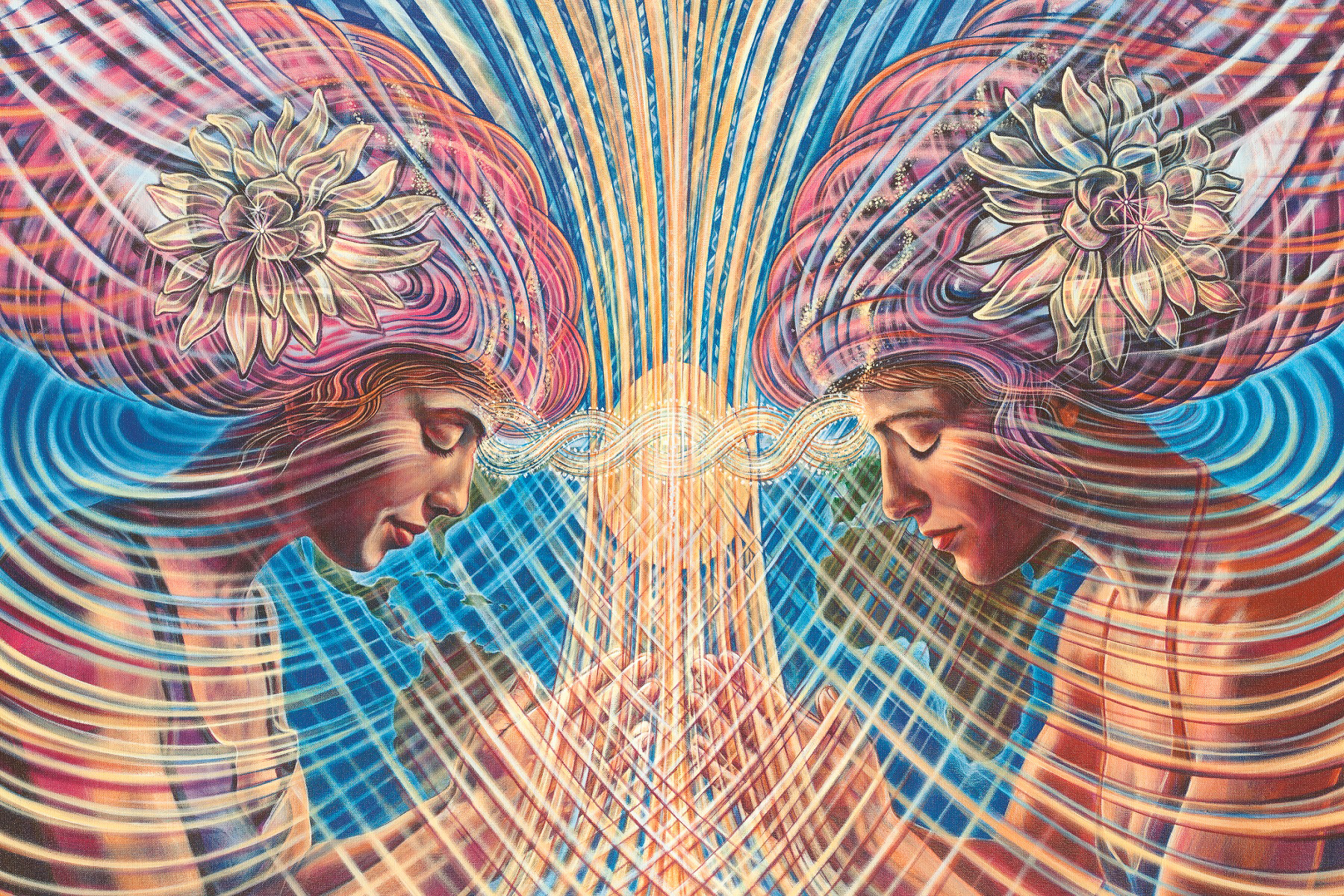
This is the second of two articles drawing together the testimonies of experienced meditators who took part in the Journey of the Soul project, an enquiry into what consciousness may encounter during and beyond the transition of physical death. The first article explored the patterns that repeatedly appeared across their accounts. Here we turn to a different and perhaps even more intriguing feature: experiences in which the meditator did not merely see something unusual, but seemed to understand its meaning at the very moment it appeared.
Seeing Is One Thing; Knowing Is Another
Deep meditation can produce remarkable experiences: Light, landscapes, geometric forms, unfamiliar realms, people, movement, Sound and altered states of consciousness.
But seeing an image and understanding its significance are not necessarily the same thing.
Someone may encounter a road, a face, a brilliant sphere of Light or a sequence of memories and only afterwards begin to ask whether the experience was connected with death, reincarnation or another level of consciousness. Such reflection may be valuable, but it is still an interpretation made after the event.
There appears, however, to be another category of experience.
At times, the meaning seems to arise simultaneously with what is being perceived. There is no obvious process of reasoning or analysis. The meditator simply knows what the experience represents.
This has sometimes been called direct knowing, intuitive knowledge or gnosis. The terminology matters less than the distinction itself: the understanding seems not to have been constructed by the ordinary thinking mind.
The experience and the knowledge appear together.
When Meaning Arrives with the Experience
A number of the Journey of the Soul testimonies contained this particular quality.
In one meditation, a face appeared and then transformed into another, followed by another. At the same time came an immediate recognition that these were previous incarnations.
There was no prolonged attempt to interpret the symbolism afterwards. The meaning seemed to be part of the experience from the beginning.
On another occasion, scenes unexpectedly appeared involving children from a school attended more than fifty years earlier. Once again there was an immediate association, this time with the possibility of a life review.
Another meditator experienced white Light moving upwards through the body and leaving through the crown of the head. Accompanying the vision was an understanding that this could represent the soul separating from the physical body.
In a further meditation, mantra and Light appeared to carry the meditator towards a realm containing familiar spiritual presences. The whole experience brought with it a powerful sense that something connected with the transition at death was being revealed.
The imagery in these accounts is very different.
What connects them is that the experience seemed to contain information as well as imagery.
Separating Gnosis from Later Interpretation
This distinction becomes important if accounts of deep meditation are to be examined carefully rather than simply accepted or dismissed.
The human mind is extremely capable of creating explanations retrospectively. A powerful vision may be remembered, discussed and gradually fitted into an existing spiritual or philosophical framework.
For that reason, an interpretation developed later should not automatically be regarded as part of the original experience.
A useful approach is to separate three different elements:
● What was actually experienced.
● What was immediately understood or known while it was happening.
● What was considered or interpreted afterwards.
Later reflection can certainly be valuable. Connections may become apparent only when an experience is examined in the light of other knowledge or testimony.
But direct knowing belongs in a different category.
When an image appears and the meditator simultaneously understands its significance without any apparent conscious reasoning, another question arises: where has that knowledge come from?
Perhaps it arises from deeper regions of the individual’s own consciousness.
Perhaps knowledge normally inaccessible to the surface mind becomes temporarily available.
Or, from a wider spiritual perspective, consciousness may sometimes become receptive to information that does not originate solely within the familiar personality.
The experience by itself cannot establish which of these explanations is correct.
What matters is that the distinction between immediate knowing and later interpretation is preserved.
Life Review as Recognition Rather Than Judgement
The possibility of a life review becomes particularly interesting when considered in this way.
One meditation contained a succession of images covering different periods of childhood and adult life. The scenes arose one after another and were simply observed before fading away.
There was no overwhelming sense of judgement, punishment or reward.
Instead, the accompanying understanding concerned learning and evolution.
Another meditator encountered people and relationships from the past, raising the possibility that experiences carrying emotional, personal or spiritual significance may remain present within consciousness when the distractions of physical life are removed.
This suggests that a life review need not necessarily resemble watching a complete film of everything that has happened.
It might instead involve becoming directly aware of the relationships, decisions, experiences and recurring patterns through which consciousness has developed.
Its purpose may therefore be understanding rather than judgement.
A deeper possibility is that after physical death the personality encounters itself with an unusual degree of clarity. Once the constant demands of physical existence have fallen away, consciousness may see more directly what it has created, learned, loved, resisted or failed to resolve.
Some of the Journey of the Soul experiences appear to offer brief glimpses of such a process.
Previous Lives and a Deeper Continuity
Experiences interpreted as previous incarnations raise an even wider question about the nature of the soul.
If consciousness continues after the death of the body, then the personality expressed during one physical lifetime may be only one temporary expression of a deeper continuity.
From this perspective, reincarnation would not necessarily mean that exactly the same human personality repeatedly returns.
Instead, a deeper centre of consciousness may express itself through successive lives, gathering experience while each individual personality remains distinct and appropriate to that particular incarnation.
This makes the vision of changing faces especially interesting.
The significance lies not merely in the appearance of different faces, but in the immediate recognition accompanying them: the sense that previous lives were being shown.
Such an experience is not objective proof of reincarnation.
Nevertheless, when experiences of this kind arise spontaneously during deep meditation — particularly when the meditator was not deliberately attempting to produce them — they deserve careful consideration.
They raise the possibility that memory exists at levels deeper than ordinary autobiographical recollection.
What the everyday personality can remember may represent only a small part of what consciousness contains.
Communication Beyond Language
Another recurring possibility suggested by deep meditative states is that communication need not always occur through words.
Some of the most significant Journey of the Soul experiences involved no conventional conversation at all.
Instead, there was recognition.
A meditator might enter an unfamiliar realm and simply know that certain beings or presences were there.
There might be an unmistakable feeling of being recognised, welcomed or loved despite nothing having been verbally expressed.
An image could appear together with its meaning.
Movement through Light or Sound could carry an understanding of transition.
A realm never encountered through the physical senses might nevertheless produce an extraordinary sense of familiarity.
Experiences of this kind suggest that communication at deeper levels of consciousness may operate differently from communication in ordinary physical life.
Words are necessary when separate human minds exchange information through spoken or written language.
But if consciousness at deeper levels is less divided than it appears to be in physical existence, information might sometimes be received more directly.
Meaning could come before language.
An experience may initially be received as a single unified whole, with the thinking mind translating it into words only afterwards.
This may also explain why profound spiritual experiences can be so difficult to describe.
Something understood almost instantaneously must later be reconstructed one sentence at a time.
Where Could Direct Knowing Arise?
There are several possible explanations for this phenomenon.
One is psychological. Meditation may allow material normally held beneath conscious awareness to become accessible.
Another possibility is that individual consciousness extends far deeper than the everyday thinking mind. Information that seems newly received may actually emerge from levels of the self that are normally hidden from ordinary awareness.
There is also a more far-reaching possibility.
Consciousness itself may not be entirely individual.
If individual awareness participates in some greater field of consciousness, then sufficiently deep meditation might weaken the normal boundaries of personality and allow information to arise from beyond the familiar self.
From this perspective, what is sometimes called spiritual communication need not necessarily involve a voice transmitting information from one location to another.
It could instead involve a temporary participation in a wider state of knowing.
There is no need to force these possibilities into a single conclusion.
One of the strengths of the Journey of the Soul project is that the experiences themselves can remain primary.
First comes observation.
Then comes interpretation, approached with openness but also with appropriate care.
What repeatedly emerges from the testimonies is that deep meditation can sometimes reveal more than unusual imagery.
It can also bring understanding.
In Essence
● Some deep meditative experiences appear together with an immediate understanding of what is being perceived.
● It is important to distinguish between the experience itself, knowledge present during the experience, and interpretations formed afterwards.
● Life review may involve recognising the relationships, experiences and patterns through which consciousness has developed rather than undergoing an external judgement.
● Experiences associated with previous lives raise the possibility that consciousness contains forms of memory deeper than those available to the ordinary personality.
● Communication in deeper states may occur through recognition, presence and direct meaning rather than spoken language.
● The source of this direct knowing remains open to enquiry, but it may suggest levels of consciousness extending beyond the everyday thinking mind.
The Journey of the Soul testimonies do not require a particular belief or explanation. Their importance lies partly in the repeated suggestion that deep meditation may reveal not only unfamiliar states and experiences, but an accompanying sense of what those experiences mean. Perhaps one of the deepest questions concerning the afterlife is therefore not simply what consciousness may encounter when physical life ends, but how consciousness can sometimes appear to know before the ordinary mind has begun to understand.