Summary
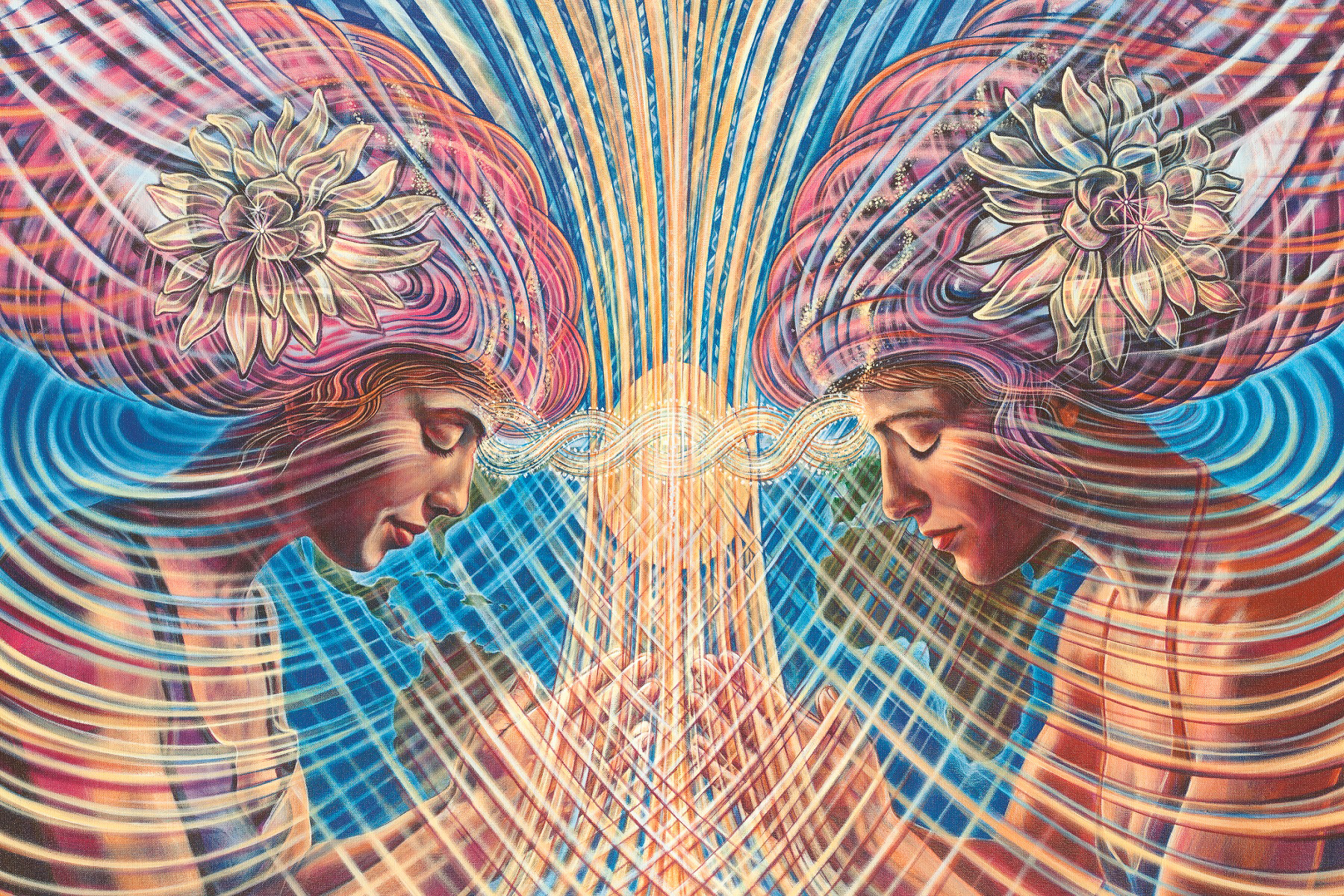
Essence may be understood as a deeper level of consciousness from which individual souls arise and through which many different streams of experience can unfold. Rather than imagining Essence as a larger being containing a collection of separate souls, it may be more helpful to picture a single source of light shining through many openings. Each beam appears separate and can travel through very different circumstances, yet all remain expressions of the same underlying light.
From this perspective, a soul may enter physical existence and experience itself as a distinct individual, with its own personality, relationships, challenges and choices. Yet its separation from Essence may never be complete. The individuality is real at the level at which it is experienced, while a deeper view suggests that behind it remains a continuing connection with the greater consciousness from which it arose.
The purpose of these individual expressions may be less about gathering knowledge and more about gaining experience. Knowledge can often be communicated, but experience must be lived. Courage, compassion, forgiveness, love, loss and understanding take on a different meaning when encountered within the limitations and uncertainties of physical existence. The soul therefore does not simply return with information about what happened; it may return changed by what it has lived.
If these experiences are ultimately integrated within Essence, then Essence itself may also develop. The process would not simply involve a perfected Essence sending souls away to learn. The greater consciousness may participate in the journey, becoming enriched through the experiences of its many expressions. Spiritual evolution can then be pictured as a spiral in which consciousness expresses itself, experiences, integrates and expands.
Essence may also not be the final level. It may itself form part of still greater structures of consciousness, until eventually our familiar distinction between the individual and the collective begins to lose its meaning. What appears from the human perspective as many separate centres of awareness may, from a much wider level, be expressions within a deeper unity.
In Essence
● Essence may be a deeper centre of consciousness from which individual souls arise.
● Souls may experience genuine individuality without becoming completely separate from their source.
● The purpose of incarnation may be less about gathering knowledge than acquiring experience that must actually be lived.
● The experiences of individual souls may contribute to the continuing development of Essence itself.
● Essence may be one level within a much greater unfolding of consciousness.
● At the deepest level, apparent separation may exist within an underlying unity.
Perhaps the central idea is that separate souls are not struggling to create a unity that does not yet exist. A deeper possibility is that the unity is already present, and that individual consciousnesses are the means through which it explores the extraordinary range of experience made possible by appearing, for a time, to become many.
Full Article
The idea of Essence begins with a simple but profound question: if the soul is not the deepest level of our identity, what lies behind it? A deeper view suggests that the Essence may be the greater centre of consciousness from which individual souls arise, through which they experience, and into which their experience is ultimately integrated.
This should not be imagined too literally. Essence is unlikely to be a larger person containing smaller persons. It may be better understood as a level of consciousness in which individuality and unity coexist in ways that are difficult to represent from within ordinary physical awareness.
What Is the Essence?
We naturally tend to picture a hierarchy:
Essence → soul → personality
This is useful at first, but it can become misleading if we imagine each level as a separate object.
The Essence may instead be a centre of individuated consciousness capable of expressing itself through many different streams of awareness.
Each soul would then be one expression of that deeper consciousness.
From within incarnation, the soul experiences itself as distinct. It develops its own history, relationships, choices and understanding. Yet at a deeper level it may never have become completely separate from the Essence from which it arose.
A helpful image is a light shining through many openings.
From the other side of the openings, we see separate beams.
From the source, there has only ever been one light.
Can One Essence Express Through Many Souls?
A deeper view suggests that it can.
But asking exactly how many souls belong to an Essence may introduce a physical idea into something that does not naturally divide into countable units.
In physical life we think in terms of separate objects. One body is clearly different from another. One person appears to occupy one location at one time.
Consciousness at the level of Essence may not be organised in quite this way.
An Essence may be capable of maintaining numerous expressions simultaneously.
Some might enter physical incarnation.
Some might experience realities we would describe as spiritual.
Others might participate in forms of existence for which our present ideas of body, place and incarnation are inadequate.
From the perspective of the individual soul, these expressions may seem separate.
From the perspective of Essence, they may be different movements of the same underlying consciousness.
Why Would Essence Create Separate Experiences?
Perhaps the most important distinction is between knowledge and experience.
Knowledge can be communicated.
Experience must be lived.
It is possible to understand the idea of courage without ever having been afraid. But knowing courage conceptually is very different from experiencing fear and choosing to act despite it.
Compassion can be described, but compassion discovered through suffering possesses another depth entirely.
The same may be true of forgiveness, patience, love, loneliness, responsibility, loss and countless other qualities.
Physical existence may therefore have extraordinary value precisely because it creates limitation.
Within limitation, consciousness encounters uncertainty.
It cannot see the whole picture.
It does not always know what will happen.
It experiences vulnerability, separation and choice.
These conditions may allow consciousness to discover possibilities within itself that could not be experienced in precisely the same way from a state of greater awareness.
The soul therefore does not simply return carrying information.
It returns changed by what it has lived.
Does the Essence Itself Develop?
If the soul is genuinely an expression of Essence, then the experience of the soul must in some sense also become the experience of Essence.
This means Essence need not be regarded as a perfected being sending immature fragments away to learn lessons.
Essence itself may participate in the process of development.
The movement could be understood as:
● Essence expresses consciousness into differentiation.
● Differentiation creates the possibility of unique experience.
● Experience transforms the individual expression.
● That transformed experience is integrated into Essence.
● Essence is consequently enriched by what has occurred.
This would make spiritual development less like a circle and more like a spiral.
Something emerges from Essence and eventually returns towards its source, yet neither the returning consciousness nor the Essence receiving it is precisely as it was before.
The journey has changed the whole.
Enlightenment and the Relationship with Essence
Enlightenment may reveal something particularly important about this relationship.
It need not mean that the individual soul suddenly disappears.
Instead, consciousness may become capable of recognising individuality and unity at the same time.
At first there is the ordinary identification:
“I am this person.”
Later there may come the recognition:
“I am the consciousness experiencing this person.”
Deeper still:
“I arise from a greater consciousness.”
And perhaps eventually:
“The separation between that greater consciousness and myself was never absolute.”
Individuality may therefore remain, but its meaning changes.
The enlightened consciousness can continue to think, speak, act and relate to others while no longer experiencing the personality as the whole of what it is.
This may explain why highly developed consciousness can remain active within the world rather than simply dissolving into some greater state.
The individual expression continues, but it knows something of its source.
What Lies Beyond Essence?
It would be easy to reach the idea of Essence and make it the final level.
Yet there is no particular reason to assume that consciousness stops there.
Essences themselves may participate within still greater organisations of consciousness.
Those greater forms may themselves exist within wider levels.
At some point the language of individual and collective may begin to fail, because both ideas arise from the human tendency to divide reality into separate things.
The deeper we move, the less appropriate words such as higher, lower, separate, inside and outside may become.
This leads towards an even wider possibility.
Perhaps creation is not fundamentally composed of separate consciousnesses attempting eventually to become one.
Perhaps the unity already exists.
The many may be expressions within the One.
From this perspective, creation becomes a process through which consciousness explores what can be experienced when unity appears as individuality.
The journey is therefore not simply about finding our way back to the One.
It may be the One discovering itself through the experience of becoming many.
In Essence
● Essence may be understood as a deeper centre of consciousness from which individual souls arise.
● Souls may appear separate while remaining fundamentally connected to their originating Essence.
● The purpose of incarnation may be less about gathering knowledge than acquiring experience that can only be lived within limitation.
● Essence itself may develop through the integration of the experiences of its individual expressions.
● Enlightenment may reveal individuality and unity simultaneously rather than requiring individuality to disappear.
● Essence may itself be part of still greater structures of consciousness, ultimately pointing towards a unity underlying all apparent separation.
Perhaps the deepest insight is that consciousness may not be divided beings struggling to become whole. It may already be whole, exploring itself through countless perspectives, lives and levels of experience. What appears from below as separation may, from a greater level, be the extraordinary way in which the One comes to know the possibilities within itself.