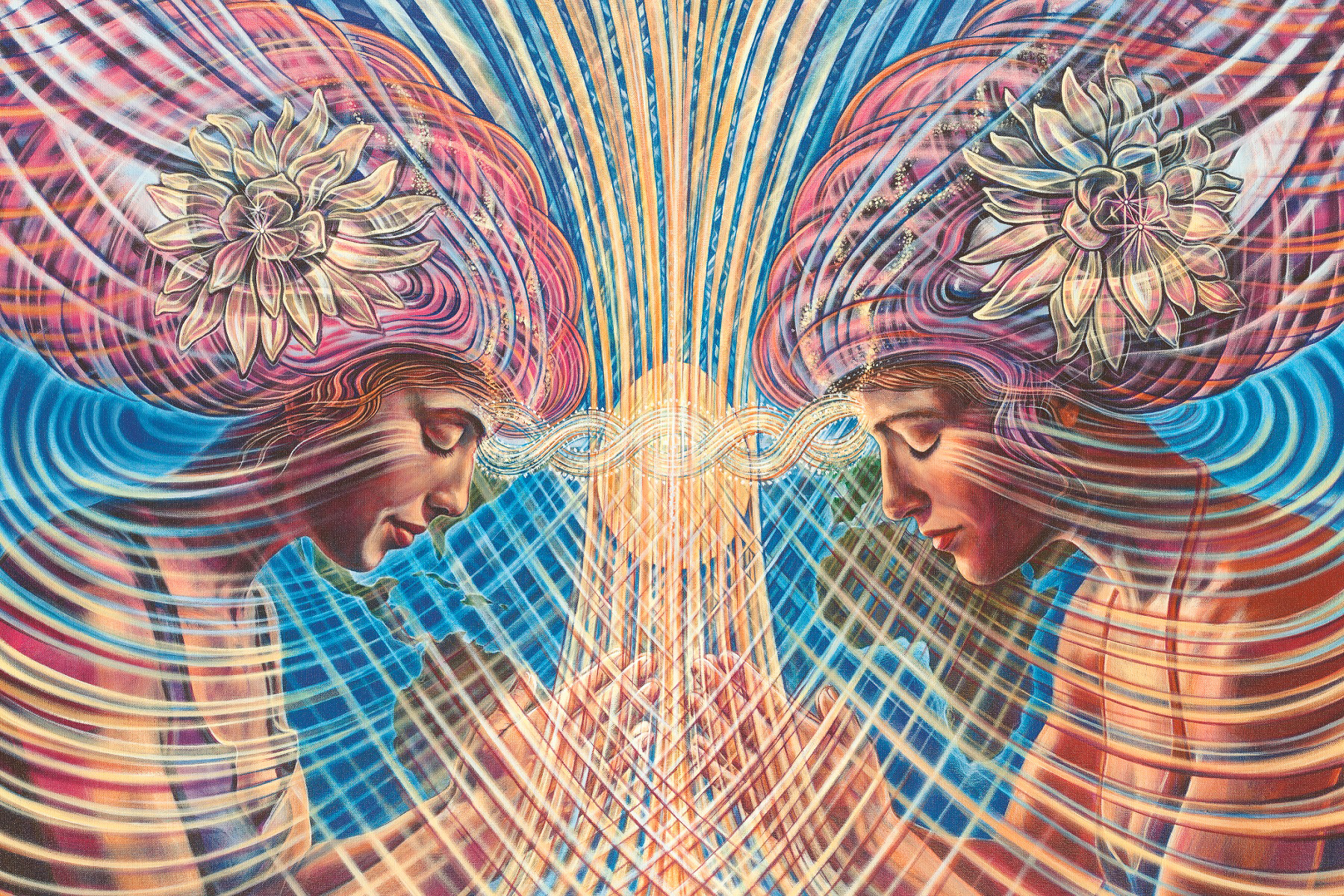
The question here is simple but profound: if human beings devote themselves deeply to very different fields of study, do they ultimately arrive at a similar inner conclusion? A biblical scholar, a physicist, a botanist, a chemist, a philosopher, or someone quietly contemplating a single drop of water may appear to be travelling along very different paths. Yet a deeper view suggests that sincere enquiry, when followed far enough, often leads to the same threshold of humility, wonder, and mystery.
The Many Roads of Human Enquiry
People are drawn to truth through many different doors. One person may spend years immersed in sacred texts, studying symbolism, language, and the deeper meanings hidden beneath ancient words. Another may devote a lifetime to the study of nature, examining the structure of a flower, the behaviour of bees, or the subtle intelligence woven through ecosystems.
Others may be drawn to chemistry, trying to understand how matter behaves at the molecular level, or to physics, exploring gravity, electromagnetism, time, and the strange architecture of the cosmos. Some are captivated by consciousness itself, while others are moved by beauty, mathematics, or the patterns found in a single living cell.
On the surface, these paths appear very different. They use different tools, different methods, and different vocabularies. Some rely on observation, some on experiment, some on contemplation, and some on inward reflection. Yet beneath these differences lies a common impulse: the desire to understand what reality is, how it works, and what our place within it might be.
This common impulse is worth noticing. It suggests that however varied our interests may seem, something deeper in the human being is always reaching toward the same hidden centre.
What Deep Study Eventually Reveals
At the beginning of any field of enquiry, knowledge often feels empowering. We learn names, systems, structures, and theories. We begin to feel that the world is becoming clearer and more understandable. There is real value in this stage, because disciplined study refines the mind and teaches us how to see more carefully.
But if the enquiry continues and becomes truly deep, something begins to shift. The more one sees, the more one also senses what remains unseen. Every answer opens into further questions. Every model explains something, but not everything. Every apparent certainty begins to reveal its edges.
A scholar may master texts and still wonder what living truth lies beyond interpretation. A scientist may discover elegant laws and still be unable to say why reality exists at all. A naturalist may understand biological processes in great detail and yet remain awestruck by the sheer presence of life itself.
This is a subtle but important turning point. Knowledge no longer inflates the self in the same way. It begins instead to expose the vastness of what cannot yet be grasped.
The Boundary of Intellect
There comes a stage in serious enquiry where intellect reaches a kind of frontier. This does not mean the mind has failed, nor does it mean that reason has no value. It means that the mind, however brilliant, is finite. It can observe patterns, form concepts, and construct useful frameworks, but it cannot fully contain the totality of existence.
This boundary can appear in many forms. It may arise when one confronts the origin of consciousness, the nature of time, the mystery of life, or the question of why there is something rather than nothing. It may arise in meditation, in science, in philosophy, or in the quiet contemplation of nature.
At that frontier, the person may realise that they are no longer dealing merely with problems to be solved, but with realities that exceed the grasp of the analytical mind. The intellect can bring us to the edge, but it cannot always carry us beyond it.
This recognition is not a defeat. In many ways, it is a maturation. It is the moment when intelligence becomes honest enough to recognise its own limits.
Why Humility Is a Sign of True Understanding
Shallow knowledge can produce certainty too quickly. It can create the illusion that because something has been described, it has been fully understood. Deep knowledge tends to have the opposite effect. It softens the ego and introduces a quiet humility.
The person who has looked deeply into any field often becomes less dogmatic, not more. They have seen enough complexity to know that simplistic conclusions rarely do justice to reality. They understand that language points, but does not capture. They appreciate that explanation is not the same as essence.
This is why some of the wisest people carry a certain gentleness. They may know a great deal, but they no longer cling to knowledge as a badge of superiority. They have seen too much of the unknown for that. They recognise that the universe is not a possession of the mind, but a mystery in which the mind itself participates.
Humility, then, is not ignorance. It is often the natural fragrance of deeper seeing.
From Explanation to Awe
When the boundary of intellect is reached with sincerity, something beautiful can happen. The need to dominate reality through explanation begins to relax, and in its place comes awe. This awe is not childish fantasy or emotional excess. It is the clear and steady recognition that existence is far more profound than our concepts of it.
Awe may arise in very different contexts. It may come to the person who studies ancient teachings and suddenly senses the depth to which they were pointing. It may come to the physicist who sees elegant order in the laws of nature yet cannot explain the source of that order. It may come to the botanist who sees astonishing intelligence in a flower, or the biologist who witnesses the coordination of a hive or colony.
At such moments, the response is often the same: silence, gratitude, and wonder. One sees not only how much can be known, but how much remains mysterious. One senses that reality is not merely a mechanism, but something profoundly alive, ordered, and astonishing.
This does not require abandoning scholarship or science. Rather, it places them in a larger frame. Study becomes not just a gathering of information, but a path that can lead the soul toward reverence.
The Shared Destination Beneath Different Paths
From this perspective, the apparent divisions between disciplines begin to soften. Sacred study, scientific enquiry, philosophical reflection, and close observation of nature may all serve as valid approaches to truth. They differ outwardly, but inwardly they may converge.
They converge not because all ideas are identical, nor because all conclusions are interchangeable, but because deep sincerity tends to bring the seeker to a similar inner posture. That posture includes openness, humility, wonder, and a recognition that human beings are small participants within an immeasurably greater whole.
This may be one of the hidden gifts of lifelong study. It does not simply fill the mind. It can refine the being. It can bring a person to the point where they bow their head, not in defeat, but in reverence before the mystery of creation.
In that sense, it matters less where one begins than how deeply one is willing to look. The scholar of scripture, the student of consciousness, the scientist, and the lover of nature may all discover, in their own way, that the deepest truth is not something the ego can own. It is something before which the heart grows quiet.
In Essence
● Deep study in very different fields often leads toward a similar inner threshold.
● Knowledge becomes more honest as it begins to recognise its own limits.
● The boundary of intellect is not failure, but a natural stage in serious enquiry.
● True understanding often produces humility rather than arrogance.
● Awe and wonder may arise when explanation gives way to direct recognition of mystery.
● Different outward paths can lead to the same inward response of reverence and gratitude.
Perhaps the real fruit of study is not merely that we learn more facts, but that we become more capable of wonder. When that happens, we do not end empty-handed. We arrive with a quieter mind, a humbler heart, and a deeper sense that we are part of something vast, beautiful, and still not fully known.